Sponsored By:
The Fed held rates, CPI came in at 2.4%, and analysts still expect 12.5% Q1 earnings growth — but estimates have already been cut across nine sectors and the S&P 500 is stretched above its 5- and 10-year average forward P/E. Trading earnings on headlines alone in this environment is a costly mistake.
The free Earnings Season eBook breaks down the exact pre-report checklist, how to weigh guidance and expectations, and how to read the first reaction after numbers hit — so you're never improvising after the move already started.
Get the Free Earnings PlaybookBy clicking the link above, you will receive this free report and a free subscription to the StockEarnings daily email newsletter. You are also agreeing to the terms of our Privacy Policy. Unsubscribe at any time.

Five stories today that all point the same direction: when government power and corporate money get tangled up, somebody pays. Make sure it’s not your business, your taxes, or your portfolio.
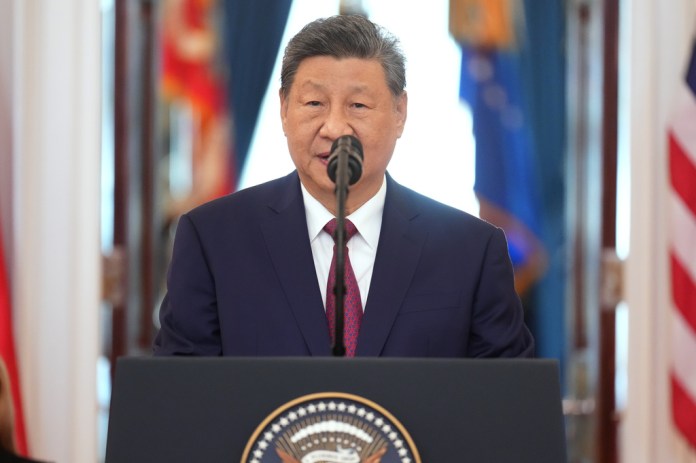
Image via Washington Examiner
Corporate America Keeps Chasing China’s Consumer Dream. The Dream’s Over.
A lot of big-name executives keep showing up for the photo ops and state dinners, hoping to crack the code on China’s so-called rising middle class. The pitch has been the same for years: build the brand, play nice, and sooner or later you’ll sell to a billion customers. But the on-the-ground reality is uglier—Chinese consumers are tapped out, confidence is down, and Beijing has shown it’s perfectly comfortable with weaker household spending if it serves the Party’s control.
When a system punishes private success, leans on companies to serve political ends, and treats property and capital like tools of the state, you don’t get a healthy consumer engine. You get precautionary saving, capital flight, and people keeping their heads down. That’s not a market you build a long-term growth plan around, and it’s not a place to assume your profits are safe just because the banquet tables are full.
🏛 Wade's Take: If you’re a CEO betting your next decade on China’s consumer “boom,” you’re not investing—you’re gambling with shareholder money. Xi doesn’t want a wealthy, confident middle class with leverage; he wants a manageable one that stays dependent. As an investor, I’d rather own American businesses with pricing power at home than chase margin in a country where the rulebook changes overnight.

Image via RedState
Near-Miss at RAF Fairford: This Is What Security Complacency Looks Like
A reported near-attack at RAF Fairford is the kind of story that should make every American sit up straight, especially when U.S. assets and personnel are involved. Even when something is stopped in time, the lesson isn’t “see, it worked”—the lesson is that the attempt happened at all, and somebody thought it had a chance.
Our overseas posture depends on host-nation competence, tight coordination, and a clear understanding that the threat environment has changed. Europe has dealt with years of radical networks, porous migration pressures, and a political class that too often treats security as an embarrassing afterthought. When counterterror failures pile up, it’s not just a policy problem—it’s operational risk for American lives and American strategic interests.
🏛 Wade's Take: You don’t run a business by celebrating near-bankruptcies, and you don’t run national security by calling near-misses “proof the system works.” If the UK has gaps, we need them identified, fixed, and verified—fast—because the next attempt won’t come with a warning label. The price of weak enforcement is always paid later, and it’s usually paid in blood and chaos.
📎 RedState

Image via Western Journal
Government-Owned Capitalism: The Fast Lane to Political Favoritism
The idea that the federal government can take ownership stakes in private companies and still behave like an honest referee is a fantasy. Once Washington is a shareholder, it stops being just a regulator and becomes a player with a financial motive. That changes incentives across the board: procurement decisions, enforcement priorities, and which industries get “strategic” protection versus which get left to bleed.
Supporters dress it up as national security, industrial policy, or stability. But the practical outcome looks like this: politically connected firms get capital, smaller competitors face a tilted field, and the taxpayer silently becomes the bagholder if the bet goes bad. Markets can handle risk. What they can’t handle is a government that picks winners, subsidizes them, then rewrites the rules to keep them winning.
🏛 Wade's Take: I’m a free-market guy because I’ve lived what happens when incentives are real and losses are real. When government becomes an owner, losses get socialized and profits get politicized. If Washington wants to protect critical supply chains, write clear rules and enforce them—don’t turn my tax dollars into a venture fund for whoever has the best lobbyists.
Court Backs Pentagon on Anthropic: National Security Comes Before AI Hype
A federal appeals court has upheld the Pentagon’s designation that effectively blocks AI firm Anthropic from certain military contracting due to supply chain risk concerns. That’s a big deal in an era when AI companies are treated like the next oil majors—too important to question and too trendy to slow down.
Whether you love or hate the decision, the underlying signal to the market is clear: defense contracting is moving into a tighter, more suspicious posture on AI, data handling, and vendor exposure. That means higher compliance costs, more screening, and potentially a bifurcated tech ecosystem where some firms are “cleared” and others are shut out. Investors should understand that regulatory and national-security risk is now a core part of valuing AI, not an afterthought.
🏛 Wade's Take: If the Pentagon thinks a supplier is a risk, I want them to have the authority to say no, even if it upsets a few venture guys and conference panels. National defense isn’t a sandbox for “move fast and break things.” From an investing angle, this is a reminder: the winners in AI won’t just be the smartest models—they’ll be the firms that can meet security standards and keep Washington confident.
📎 OANN

Image via Just the News
New York’s Medicaid Mess: Taxpayer Money Paid for Inmates Who Weren’t Eligible
A federal audit found New York made millions in improper Medicaid payments for incarcerated individuals, including cases where someone stayed enrolled in managed care for nearly two years while behind bars. In plain English: the system kept paying as if nothing had changed, and nobody caught it soon enough.
This isn’t just a paperwork problem—it’s a management problem. Any business owner knows you don’t keep paying invoices for services not being delivered, and you don’t excuse it with bureaucracy. When states run massive benefit programs without tight controls, the leakage adds up, and working taxpayers get told to accept higher costs as if it’s the weather.
🏛 Wade's Take: Every dollar wasted on improper payments is a dollar that has to be replaced with higher taxes, more debt, or reduced care for people who actually qualify. New York doesn’t need a press conference; it needs basic operational discipline and consequences for repeated failures. If a private company burned cash like this, heads would roll—government shouldn’t get a softer standard.
That’s the roundup for Monday. Keep your overhead tight, your balance sheet honest, and your eyes open—because the folks in charge rarely pay for their own mistakes, but they’re always happy to send you the bill. Wade Lawson Editor, The Local Conservative
— Wade Lawson