Sponsored By:
That "Trump Bump" Social Security raise? Already gone. Medicare premiums, gas, groceries — they've swallowed every penny before it hits your account. Meanwhile, your benefits have already lost 13.7% of their purchasing power since 2016, and the system would need to raise checks by 15.7% just to break even. You're getting $81. You needed $296.
Central banks have been quietly buying one specific asset at the fastest pace in 50 years — and JP Morgan now sees it hitting $8,000. Smart retirees aren't waiting on the next COLA. They're protecting what's left right now. Get the free guide and see the 3 steps disciplined retirees are using to outrun the inflation Washington can't stop.
Get the Free Wealth Preservation GuideThis is an advertisement. If you no longer wish to receive our promotionals, please let us know. Or write to: 5005 Lyndon B. Johnson Fwy. Suite 350, Dallas, TX 75244

Today’s stories look unrelated until you follow the incentives: governments trying to manage perception, media figures laundering bad ideas, regulators squeezing everyday Americans, campaigns fighting over the Midwest, and a once-in-a-century investor handing over the keys.
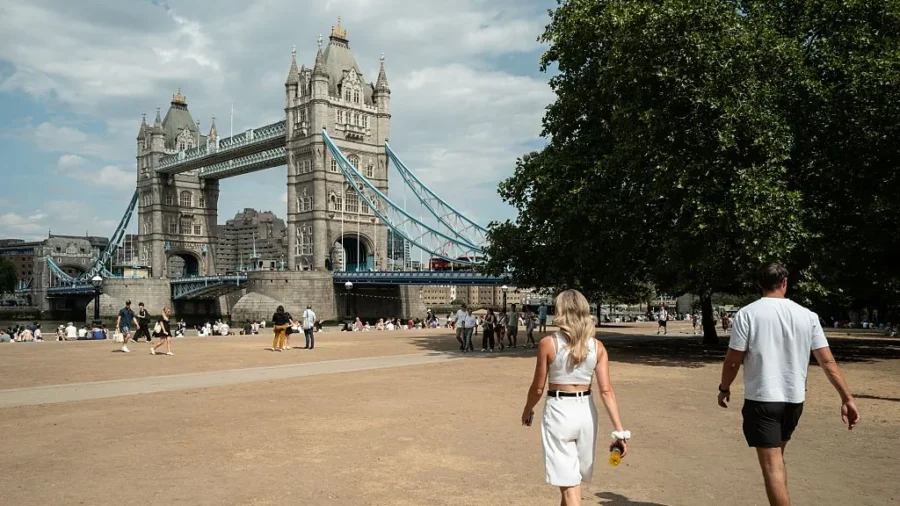
Image via NTD
America Tells Travelers: Keep Your Head on a Swivel in the UK
The U.S. renewed its travel advisory for the United Kingdom, citing crime concerns and the ongoing risk of terrorism. London is still one of the world’s great cities, but the message from our own government is simple: don’t confuse a familiar accent with a safe environment.
For families booking fall trips, this isn’t just about personal safety. It’s about the ripple effects when a country’s public order slips: higher insurance costs, more private security, more headaches for hospitality and retail, and fewer tourists willing to spend freely.
From an investor’s angle, travel advisories are a soft indicator of harder problems. When officials feel the need to put it in writing, it usually means the trend line has been moving the wrong way for a while.
🏛 Wade's Take: A society that can’t keep streets safe can’t keep business confidence high, either. Conservatives should stop pretending public order is “someone else’s issue” once it’s overseas, because we’re watching the same playbook at home in certain cities. If you’re traveling, act like a businessman on a cash run: plan, stay alert, and don’t let optimism replace situational awareness.
📎 NTD
The Left Keeps Finding Room for Antisemitism—As Long as the Politics Line Up
A new report spotlights praise from progressive political figure Abdul El-Sayed for comedian and commentator Bassem Youssef, whom the piece describes as pushing conspiratorial and antisemitic themes. The article also notes media personality Mehdi Hasan has called Youssef a “good friend,” raising fresh questions about what modern “anti-hate” standards really mean in certain political circles.
The uncomfortable part isn’t that comedians take swings. It’s that influential people keep running cover when the target is Jews, or when the rhetoric can be repackaged as “just anti-Zionism” while it leans on old, ugly stereotypes.
For business owners and investors, this matters because social cohesion is economic infrastructure. When the cultural gatekeepers normalize bigotry, it invites polarization, workplace conflict, reputational risk for brands, and pressure campaigns that can hit anyone who doesn’t chant the approved slogans.
🏛 Wade's Take: If your “values” only show up when the offender is on the other team, you don’t have values—you’ve got a PR strategy. Conservatives should call out antisemitism plainly, no qualifiers, no word games, and no outsourcing our moral backbone to cable panels. A country that can’t draw clean lines around basic decency isn’t a stable place to build, hire, and invest.

Image via The Hill
Vance in Iowa, Trump Teases Healthcare: The Midwest Is the Whole Ballgame
With November races tightening, Vice President JD Vance is campaigning in Iowa while President Trump sets up a healthcare announcement. The broader battlefield is clear: historically red Midwestern territory is seeing Democrats try to pry open seats by selling “moderation” while governing like the same old progressive machine.
On the ground, voters aren’t debating theory. They’re feeling grocery bills, insurance premiums, rent, and whether their kids can stay in-state and still afford a starter home. That’s why the Midwest stays decisive: it’s America’s reality check, and politicians ignore that at their peril.
Healthcare is the looming landmine. It’s one of the biggest line items for employers after payroll, and any serious reform has to address cost drivers, competition, and the incentives that keep prices climbing while quality stays uneven.
🏛 Wade's Take: If Republicans want to win the Midwest, talk like employers and households actually live: wages in, costs out, and fewer middlemen taking a cut. Don’t over-promise a magic healthcare fix; lay out practical steps that help small businesses offer coverage without getting crushed. The party that sounds most grounded on cost of living and work will carry these races.
📎 The Hill

Image via RedState
Trump Targets Biden-Era Rules That Treated Outdoorsmen Like a Problem to Be Managed
The administration is moving to roll back a set of Biden-era regulations that, according to critics, piled new restrictions onto boaters, hunters, and fishermen. The push is being framed as restoring common-sense access and easing compliance burdens that hit ordinary Americans who use public waters and lands responsibly.
A lot of people hear “outdoors regulations” and think it’s niche. It’s not. It’s fuel docks, marinas, guide services, equipment sales, boat storage, rural tourism, and the weekend economies of small towns that don’t have venture capital money floating around.
Regulation has a cost, and it’s rarely paid by the people writing the rules. It’s paid by the guy running a bait shop, the family trying to afford a used jon boat, and the small operator who can’t hire an attorney every time Washington “clarifies” something.
🏛 Wade's Take: I’ve lived through enough rule changes to know that agencies don’t just regulate behavior; they regulate confidence. When the government treats citizens like suspects for enjoying the outdoors, it’s not stewardship—it’s control dressed up as virtue. Roll back the paperwork, enforce real conservation, and let law-abiding people live their lives without a federal babysitter.
📎 RedState
Buffett Steps Down: The Oracle Hands Off the Crown as Markets Brace for a New Era
Warren Buffett announced he is stepping down as Berkshire Hathaway’s chairman, saying “Father Time always wins.” He named his son, Howard Buffett, as his replacement effective immediately, marking a historic transition at one of the most closely watched capital-allocation machines in American business.
For investors, this isn’t just a leadership change; it’s a psychological marker. Buffett has been a steady hand through inflation scares, rate shocks, bubbles, crashes, and everything in between. When a figure like that exits the stage, markets inevitably reprice the idea of “certainty,” even if Berkshire’s bench is deep.
The bigger question is how Berkshire’s culture holds: patient capital, disciplined deal-making, and a bias toward cash flow over hype. That philosophy is harder to sustain than people think, especially in an era where headlines move money faster than fundamentals.
🏛 Wade's Take: Buffett’s real gift wasn’t stock picking—it was temperament, and that’s the rarest asset in markets. This is a reminder to own businesses you understand, demand real cash generation, and stop chasing whatever’s loudest on your phone this week. If you’ve built your financial house on leverage and vibes, Father Time isn’t your only problem.
That’s the roundup. Keep your powder dry, read the incentives, and don’t let politics distract you from the balance sheet.
— Wade Lawson