Sponsored By:
The Fed held rates, inflation is still above target, and uncertainty is rising — that means the "buy anything AI" trade is over. Smart money is rotating fast toward the companies actually building AI infrastructure: chips, cloud capacity, and mission-critical data tools. Big Tech alone is projected to spend $635B–$665B on AI in 2026 — and not all of it is going where most investors are looking.
We've identified 9 AI stocks worth watching right now — including a lesser-known chip name tied to U.S. AI infrastructure, a cloud player with improving setup, and a data analytics company with government exposure. This isn't hype. It's about following where capital is actually being deployed.
Get the Free Report NowBy clicking the link above, you will receive this free report and a free subscription to the StockEarnings daily email newsletter. You are also agreeing to the terms of our Privacy Policy. Unsubscribe at any time.

Five stories that all point to the same question for conservatives: who’s serious about stability, and who’s playing games with the country’s balance sheet.

Image via Fox News
Trump Shrugs Off Impeachment Talk, But The Country Can’t Afford Another Stunt
In an interview clip making the rounds, President Trump said he “can’t imagine” Democrats would try to impeach him a third time. Given the last decade of Washington behavior, I can imagine it just fine. The real question is whether the political class has learned anything about what constant crisis does to a nation’s confidence.
Impeachment theater isn’t just a cable-news food fight. It bleeds into markets through uncertainty, slows hiring decisions, and makes every business owner wonder what new “emergency” is going to hit their costs next. When you run payroll and renew leases, you learn fast that instability has a price tag.
If Democrats go down that road again, they’ll sell it as “accountability.” But voters are going to see it as a substitute for governing, especially if kitchen-table issues like inflation, rates, and energy remain the pressure points.
🏛 Wade's Take: Washington has treated impeachment like a fundraising product, and that’s poison for business confidence. If Democrats want to beat Trump, do it the old-fashioned way: make your case, win elections, and govern better. The third time wouldn’t be “historic,” it’d be proof the Left can’t quit the chaos.
📎 Fox News

Image via The Federalist
A 99-Vote Margin Is Exactly Why Election Integrity Isn’t “Paranoia”
A North Carolina House race reportedly separated by 99 votes is a clean reminder of something the press loves to dismiss: “rare” problems still matter when margins get razor-thin. The argument isn’t that every election is corrupt. The argument is that close elections turn small administrative failures into big legitimacy crises.
Noncitizen voting is one of those topics where the establishment tries to shame people out of asking basic questions. But if even a tiny number of ineligible ballots slip in, and the margin is double digits or low triple digits, you’ve got a dispute that poisons trust for years.
For small business owners, trust in institutions isn’t an abstract concept. It affects everything from where companies expand to whether families feel safe investing in a neighborhood, buying a home, or starting a business. Stable rules and clean elections are part of the same foundation.
🏛 Wade's Take: Secure elections are like clean audits: most of the time you don’t need them because you did things right, but you still run them because the cost of getting it wrong is enormous. We should have universal citizenship verification, clean voter rolls, and real penalties for violations. If the Left is so sure it never happens, they shouldn’t be afraid of systems that prove it.
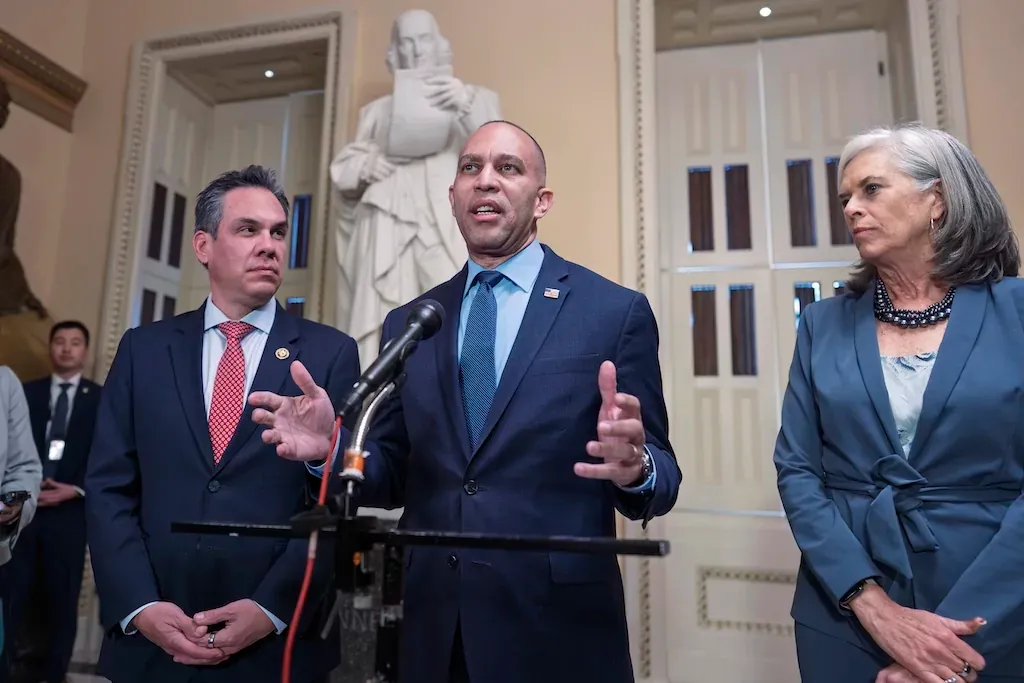
Image via Washington Examiner
Progressives Won’t Back Jeffries: Dems Aren’t Unified, They’re Negotiating Hostages
A new bloc of incoming progressive Democrats is reportedly refusing to commit to Hakeem Jeffries as speaker, signaling internal leverage plays before the gavel even hits the desk. That’s the modern House: factions treating leadership votes like a merger negotiation, with side deals and demands attached.
On the surface, this is a Democrat problem. In practice, it affects everyone because it shapes what legislation even gets a floor vote. If Jeffries has to buy votes with policy concessions, you can expect more aggressive spending priorities, more regulatory muscle, and more ideological riders that spook capital.
Markets and business planning hate political fragility. When leadership is weak, you get lurching governance: short-term continuing resolutions, last-minute “must-pass” packages, and rule-by-crisis budgeting that always seems to end with bigger deficits.
🏛 Wade's Take: When the progressive wing says “no commitment,” what they mean is “pay up.” And “pay up” usually means higher spending, heavier regulation, and more pressure on energy and capital formation. Conservatives should treat this as a warning label: the Democrats’ internal fight is about how fast they want to drive the country’s credit card, not whether they should stop swiping it.

Image via Daily Caller
Nvidia Scandal Meets China Risk: That’s A Governance Discount Waiting To Happen
Nvidia’s CEO has reportedly admitted to an extramarital affair while the company is also dealing with a corporate investigation tied to potential Chinese espionage targeting. Those are two very different issues, but they collide in one place that investors understand: governance risk.
In today’s market, Nvidia isn’t just another ticker symbol. It’s a pillar holding up major indexes, retirement accounts, and the broader “AI capex” story. When leadership gets distracted or compromised, it can invite pressure from regulators, create leverage for adversaries, and turn a high-multiple stock into a headline-driven trade.
The China angle matters because semiconductors and AI are not normal consumer products anymore. They’re strategic assets. If foreign targeting is even a credible question, boards, auditors, and Washington are going to get involved, and that’s when timelines slip and costs rise.
🏛 Wade's Take: I don’t care what Silicon Valley calls “private life” when it shows up as a corporate vulnerability. In the real world, compromise is compromise, and America’s strategic tech sector can’t be run like a college dorm. If you own Nvidia, understand you’re not just buying growth; you’re buying management discipline and geopolitical exposure, too.

Image via NTD
U.S. Stops Vessel In Iran Blockade: Keeping Sea Lanes Open Keeps Prices Down
U.S. forces stopped a vessel breaching an Iran blockade, with unclassified CENTCOM footage showing a strike on the stern of the M/V Huda in the Gulf of Oman on Nov. 7. That region isn’t just a map location; it’s one of the world’s economic choke points.
When shipping lanes get threatened, insurance rates jump, rerouting costs pile up, and energy markets price in disruption. Those costs don’t stay offshore. They show up in diesel, groceries, building materials, and every invoice that hits a small business owner trying to keep margins intact.
Deterrence is cheaper than war, but only when it’s credible. If adversaries believe they can harass commerce without consequence, you get a slow drip of instability that functions like a tax on the American economy.
🏛 Wade's Take: Peace through strength isn’t a slogan; it’s a cost-control strategy for the whole economy. If Iran or its proxies can play games in the Gulf, every American family pays the freight at the pump and at the store. Keep the lanes open, hit back decisively when necessary, and stop pretending “restraint” is free.
📎 NTD
That’s the Monday rundown. Keep your head on a swivel, your balance sheet conservative, and your politics tied to real-world consequences. Wade Lawson, The Local Conservative
— Wade Lawson