Sponsored By:
Policy is already moving markets in 2026 — trade enforcement, regulatory shifts, and tax positioning are redirecting capital right now. Institutions reposition before the headlines catch up, and the window to act early is closing fast.
Our analysts identified 5 stocks showing real momentum tied directly to current administration policy themes — including the sectors benefiting most from domestic investment trends and regulatory tailwinds. Don't get left behind.
Get the Free Report Now(By following any of the links above, you're choosing to opt in to receive insightful updates from The Investment News Daily + 2 free bonus subscriptions! Your privacy is important to us. You can unsubscribe anytime. See our privacy policy for details.)

California's Medicaid fraud, Venezuela's collapse, Trump's Iran showdown, AI's next gold rush, and the socialist takeover of New York — it's all about following the money.
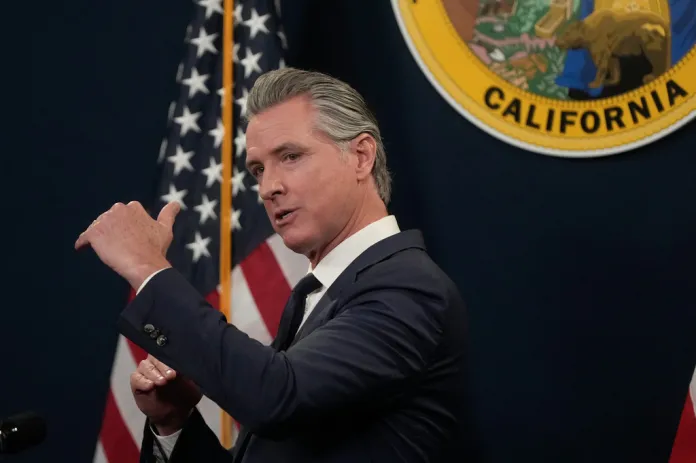
Image via Washington Examiner
California's Medicaid Shell Game: When 'Intergovernmental Transfers' Really Mean Theft
A military family relocating to California for a one-year assignment discovered what every business owner who's ever dealt with the Golden State already knows — the state has perfected the art of creative accounting that would land any private sector CFO in federal prison. The latest scheme involves something called 'intergovernmental transfers' in the Medicaid program, where California essentially creates money on paper, transfers it between government entities, and then bills the federal government for matching funds. It's not healthcare. It's a fraud dressed up in bureaucratic language.
The mechanism works like this: California forces county governments to make paper transfers to the state Medicaid program, which then triggers federal matching dollars at rates as high as 50 cents on the dollar. The counties get their money back eventually, but the state pockets the federal match. Meanwhile, actual healthcare outcomes don't improve, administrative costs balloon, and the federal deficit — funded by taxpayers in all 50 states — grows to pay for California's budget games.
This isn't about helping poor families get healthcare. It's about Sacramento gaming federal formulas to extract maximum dollars while maintaining the fiction of fiscal responsibility. The state that can't keep its lights on or its streets clean has somehow mastered the art of federal fund extraction better than any other.
🏛 Wade's Take: I've closed hundreds of commercial real estate deals, and if I ran my books the way California runs its Medicaid program, I'd be sharing a cell block with Bernie Madoff. This is exactly why federal entitlement programs are fiscal cancer — they create perverse incentives for states to maximize federal draws rather than actual outcomes. Every dollar California extracts this way comes from Tennessee, Texas, and Florida taxpayers who are subsidizing a state that's already taxing its own residents into U-Hauls.

Image via RedState
Venezuela's Earthquake Disaster: What Decades of Socialism Built
Twin earthquakes struck Venezuela on Wednesday, killing at least 164 people and leaving thousands trapped in collapsed buildings as rescue crews race against deteriorating conditions. The 6.8 and 6.2 magnitude quakes hit within hours of each other near Caracas, devastating a country whose infrastructure was already on life support after more than two decades of socialist governance under Chavez and Maduro.
What makes this tragedy particularly devastating isn't just the seismic activity — it's what socialism did to Venezuela's ability to respond. The country that once had the world's largest proven oil reserves now lacks basic emergency response equipment, functioning hospitals, and the economic capacity to mount effective rescue operations. Buildings constructed during the boom years weren't properly maintained. Emergency services have been gutted by years of economic collapse and brain drain. The international community is mobilizing aid, but getting resources into a country with destroyed ports, crumbling roads, and a government that's hostile to Western assistance is proving nearly impossible.
You're watching in real time what happens when a resource-rich nation chooses collectivism over capitalism, political loyalty over competence, and revolutionary rhetoric over boring things like building codes and infrastructure maintenance. Venezuela didn't just get unlucky with earthquakes — it systematically destroyed its own capacity to handle them.
🏛 Wade's Take: Here's your laboratory proof that all the equality rhetoric in the world doesn't mean a damn thing when the ground starts shaking and you need concrete, steel, engineers, and functioning institutions. Venezuela had more oil wealth than Norway but chose socialism instead of sovereign wealth funds and property rights. Now their people are dying in rubble while the regime that destroyed their country's capacity to respond begs for Western aid. Remember this next time some democratic socialist in Brooklyn tells you about their vision for America.
📎 RedState

Image via The Hill
Senate Backs Trump's Iran Posture: War Powers Vote Signals Bipartisan Support
President Trump declared that the Senate's defeat of yet another war powers resolution "puts Iran on notice" as his administration continues negotiations toward what he's calling a comprehensive long-term deal with Tehran. The Senate vote Wednesday rejected attempts by a handful of lawmakers to restrict the President's military options in the region, marking the third such resolution defeated since Trump took office in January 2025.
The vote comes as Trump pursues what sources describe as a grand bargain approach with Iran — combining serious military deterrence with an offer of sanctions relief and normalized relations if Tehran permanently abandons its nuclear weapons program and stops funding proxy forces across the Middle East. It's vintage Trump dealmaking: maximum pressure backed by credible military threat, paired with an off-ramp that could transform the regional security landscape.
Whether Iran takes the deal remains to be seen, but the Senate vote strengthens Trump's negotiating position considerably. Tehran now knows that Congress isn't going to tie the President's hands, and that any miscalculation on their part won't be met with resolutions and rhetoric — it'll be met with force backed by bipartisan political support.
🏛 Wade's Take: This is how you negotiate from strength, and it's something we didn't see for four years under the previous administration. Iran's regime understands exactly one language — credible threat backed by will to use it. The Senate just told them that Trump has both the authority and the political backing to act if they keep playing games. Smart money says we either get a real deal or we see targeted strikes before year-end, but the days of Iran running proxies across the Middle East while slow-walking nuclear negotiations are over.
📎 The Hill
AI Chip Rally Adds $400 Billion: Micron and Qualcomm Forecasts Light Fire Under Semiconductor Sector
Micron and Qualcomm dropped earnings forecasts Wednesday that ignited a $400 billion rally across AI chip stocks, confirming what every serious tech investor already suspected — we're still in the early innings of the AI infrastructure build-out, and the companies selling picks and shovels are printing money. Micron's guidance on high-bandwidth memory demand and Qualcomm's AI chip pipeline sent the entire semiconductor sector soaring in extended trading.
The numbers tell the story of a genuine technological shift, not a speculative bubble. Micron's high-bandwidth memory — the specialized chips that sit next to AI processors and feed them data at lightning speed — is sold out through 2027. Qualcomm's AI chips are moving from data centers into phones, cars, and edge devices, expanding the addressable market by orders of magnitude. This isn't about chatbots — it's about fundamental shifts in how computing happens and where it happens.
For investors, the question isn't whether AI is real, it's which companies in the supply chain will capture durable profits as the technology matures. The $400 billion rally suggests the market is betting that the chip makers — particularly those controlling specialized components like high-bandwidth memory and AI accelerators — have pricing power and margin expansion ahead of them.
🏛 Wade's Take: I've been overweight semiconductors since mid-2025 and this confirms the thesis — we're looking at a multi-year capital expenditure cycle that makes the cloud build-out look modest by comparison. The smart play isn't chasing Nvidia at these valuations, it's owning the component suppliers with capacity constraints and pricing power. Micron's memory and Qualcomm's edge chip story are both compelling, and neither is priced like they're going to own the next decade. This is where you make generational wealth if you get the position sizing right and don't panic when the inevitable 20% correction comes.
📎 Reuters

Image via Daily Signal
Socialist Sweep in New York: Mamdani Endorsements Signal Democratic Party's Hard Left Turn
Tuesday's Democratic primary in New York delivered a clean sweep for candidates endorsed by NYC Mayor Zohran Mamdani and aligned with the Democratic Socialists of America, marking what observers are calling a fundamental realignment of the party's urban power base. Multiple candidates critical of Israel and supportive of radical economic restructuring defeated establishment-backed incumbents in districts across New York City and the surrounding suburbs.
Mamdani, who won the mayoralty in 2025 on an explicitly socialist platform, has become the party's most effective kingmaker in America's largest city. His endorsed candidates ran on platforms calling for rent control expansion, public banking, corporate taxation increases, and what they describe as ending U.S. complicity in Israeli military actions. The victories suggest that the progressive wave that seemed to crest in 2020-2022 is actually accelerating in deep-blue urban areas, even as Republicans make gains in suburbs and swing districts.
The implications extend well beyond New York City politics. These newly elected officials will shape policy in a state that's already lost population to Florida, Texas, and other low-tax destinations. They'll influence national Democratic Party platform debates heading into 2028. And they're creating a laboratory for policies that make California look business-friendly by comparison.
🏛 Wade's Take: New York Democrats just nominated a slate of socialists who think the problem with New York is that it's not enough like Venezuela before the earthquakes. Watch commercial real estate closely in Manhattan over the next 18 months — every property owner with options is running the numbers on relocation right now. I give it three years before these policies crater the tax base so badly that even progressive voters notice, but by then the damage will be generational and the people who could afford to leave will already be gone.
Stay sharp out there. Watch your portfolio, mind your property taxes, and remember — socialism works great until you run out of other people's money or the ground starts shaking. Same result either way. — Wade
— Wade Lawson