Sponsored By:
America's national debt has blown past $40 trillion — and we're adding another trillion every five months. Interest payments alone now top $1 trillion a year, meaning borrowed money is paying interest on borrowed money. Economists call this a debt death spiral, and your retirement savings could be caught in the middle.
A new free report reveals the three ways governments escape a debt spiral, how purchasing power quietly erodes, and exactly how to move a portion of your savings into a financial safe haven before it's too late. No cost. No obligation. Delivered to your inbox in minutes.
Get the Free Debt Death Spiral ReportThis is an advertisement from American Alternative Assets. If you no longer wish to receive these promotions, unsubscribe here. American Alternative Assets | 21700 W Oxnard St, Suite 850, Woodland Hills, CA 91367.

From Rush’s timeless investing-grade calm to the media’s latest scare cycle, plus a tragic Florida crash and a revealing look at China’s tightening grip.

Image via RedState
Rush Was Right: It’s Never Time To Panic — In Politics Or Markets
Rush Limbaugh had a gift most people never develop: the ability to stay steady while the rest of the country got emotionally bid up like a meme stock. The reminder making the rounds this week is one of his best lines for conservatives who actually have something to lose: “It’s never going to be time to panic.” That mindset matters because panic is how people get stampeded into bad votes, bad investments, and bad decisions for their families.
In business, I’ve lived through rate spikes, tenant failures, and “the sky is falling” headlines that didn’t pay one bill. In politics, the same principle applies. The other side counts on conservatives burning out, turning on each other, and making dumb moves out of fear. Calm is not complacency; calm is discipline.
Rush’s broader point still holds: if you keep your bearings, you can see opportunities the crowd misses. Whether it’s a market dislocation or a policy shift, the winners are usually the ones who didn’t sell the farm at the bottom and didn’t believe every cable-news emergency alert.
🏛 Wade's Take: If you’re a small business owner or an investor, panic is a luxury you can’t afford. Build cash reserves, keep your debt maturities staggered, and stop letting every headline dictate your mood. The people trying to scare you are usually trying to move you.
📎 RedState

Image via American Thinker
“Progressive” Isn’t Progress — It’s Central Planning With Better Branding
The modern Progressive movement sells itself like it’s the next big upgrade, but it behaves more like an old, busted system: control the speech, control the economy, punish dissent, and call it compassion. The critique laid out here is simple: there’s nothing truly forward-looking about a politics that treats human nature as a spreadsheet problem and freedom as an obstacle.
What progressives call “progress” usually means more rules, more bureaucracy, and more dependence on institutions that are already failing. You can see it in housing, in energy, in education, and in public safety: policies that sound good in a faculty lounge but hit working people with higher costs and fewer options.
And when reality refuses to cooperate, they don’t adjust the model. They tighten the screws. That’s not innovation; that’s arrogance.
🏛 Wade's Take: Real progress is when families can afford a home, businesses can expand without begging permission, and communities can enforce basic order. The progressive approach inflates costs and shrinks liberty, then acts shocked when people get squeezed. I’ll take practical reform and local control over big-government experimentation every day.
The “Fascism” Alarm Is Back — Right On Schedule For The Midterms
Like clockwork, the media ecosystem is revving up another round of “fascism” warnings aimed at conservative voters and candidates. The argument isn’t subtle: label the opposition as dangerous, frame normal policy disagreements as existential threats, and hope the public votes out of fear instead of frustration.
This kind of rhetoric does two things in the real economy. First, it adds volatility: businesses delay hiring and expansion when they’re told every election is the end of democracy. Second, it gives cover for institutional overreach, because once you convince people they’re fighting “fascists,” any tactic becomes justified.
Meanwhile, the actual issues that hit households, inflation pressure, energy costs, crime, housing affordability, get treated like background noise. That’s not an accident. Fear is a substitute for performance.
🏛 Wade's Take: When someone can’t defend their record, they attack your character and your citizenship. Don’t take the bait. Vote like a business owner: focus on results, incentives, and whether your community is safer, cheaper to live in, and freer than it was two years ago.

Image via Killing Passengers, Stoking Fears of 9/11 Style Strike
Deadly Learjet Crash Near Mar-a-Lago Raises Hard Questions, Even If Accidental
A Learjet 60 went down in Palm Beach County near Mar-a-Lago, killing everyone aboard, and early reporting says authorities believe it was an accident. Still, any crash in that corridor, near a high-profile location, is going to light up public anxiety in a country that never fully forgot what aviation terror looks like.
Beyond the immediate tragedy, incidents like this put a spotlight on security posture, airspace management, and how quickly misinformation spreads when emotions are high. We’ve also got to acknowledge the operational side: maintenance standards, flight planning, and the accountability chain that keeps private aviation safe.
For Florida’s economy, Palm Beach aviation is part of the broader engine, business travel, tourism, investment traffic, and high-value commerce. Safety failures, even accidental, can ripple into tighter restrictions, higher insurance costs, and more regulatory friction for lawful operators.
🏛 Wade's Take: We should grieve for the families and let investigators do their job without the internet mob turning everything into a conspiracy. But we also shouldn’t pretend aviation safety and airspace security are “set it and forget it” systems. If there are preventable failures, fix them fast, because the costs land on everyone, from small operators to local taxpayers.
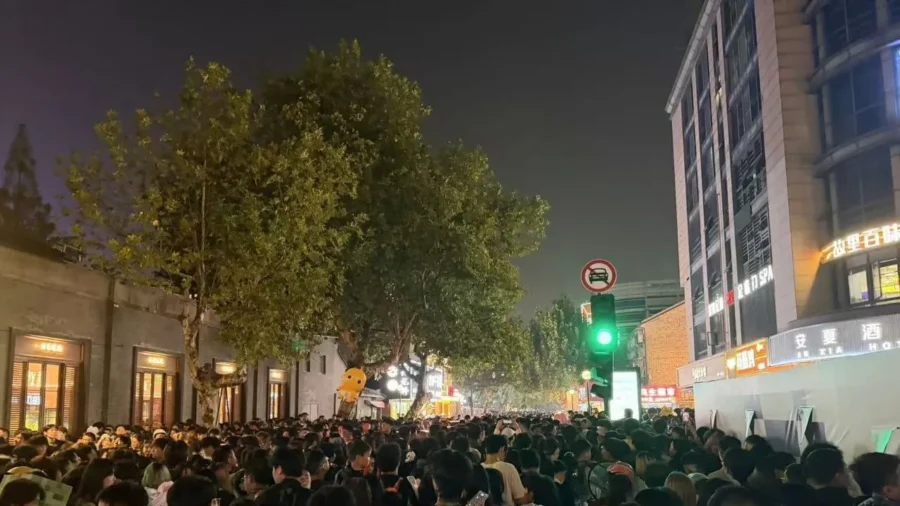
Image via NTD
Halloween Crowds In China: The Party Tightens The Leash While People Test The Limits
Footage and reports out of China showed big Halloween crowds in major cities even as the regime continues tightening social controls. That tension tells you a lot: ordinary people want outlets, culture, and a little breathing room, while the Party wants predictability, surveillance, and obedience.
China’s leadership has been leaning harder into control measures, from policing public gatherings to shaping acceptable speech and behavior. When people gather anyway, even for something as seemingly harmless as costumes and nightlife, it becomes a quiet contest over who gets to define public space.
For Americans watching markets, this is more than a cultural story. Social instability and state crackdowns can hit supply chains, consumer demand, foreign investment risk, and the reliability of China-based operations. The Party may project strength, but heavy control often signals fear of its own people.
🏛 Wade's Take: If your portfolio or your business depends on “China stability,” remember what stability means over there: force. Diversify your supply lines and your exposure, because political risk in China is not theoretical, it’s policy. The freer a society is, the more durable its economy tends to be, and Beijing knows it.
📎 NTD
I’m Wade Lawson. Keep your powder dry, your balance sheet strong, and your eyes on who’s trying to move your money and your mind. See you next issue from The Local Conservative.
— Wade Lawson