Sponsored By:
Tax season quietly reshapes where capital flows — refunds hit accounts, portfolios get rebalanced, and positions get liquidated to cover obligations. That creates unusual early movement in small-cap stocks that has nothing to do with company fundamentals. Right now, certain names are already showing structural signals most investors will miss entirely.
We've put together a free Market Structure Guide breaking down how tax season shifts market activity, why some small-cap profiles move unexpectedly in March and April, and three companies already showing early breakout signals. The window to act before broader attention arrives is narrow — don't wait.
Get the Free Market Structure Guide*We encourage readers to perform their own research and due diligence on any information we provide. By clicking the link you will automatically be subscribed to the Fierce Investor Newsletter. Privacy Policy

From Versailles to Detroit, the real costs of doing business with our enemies — plus why the unions might finally price themselves out of a job
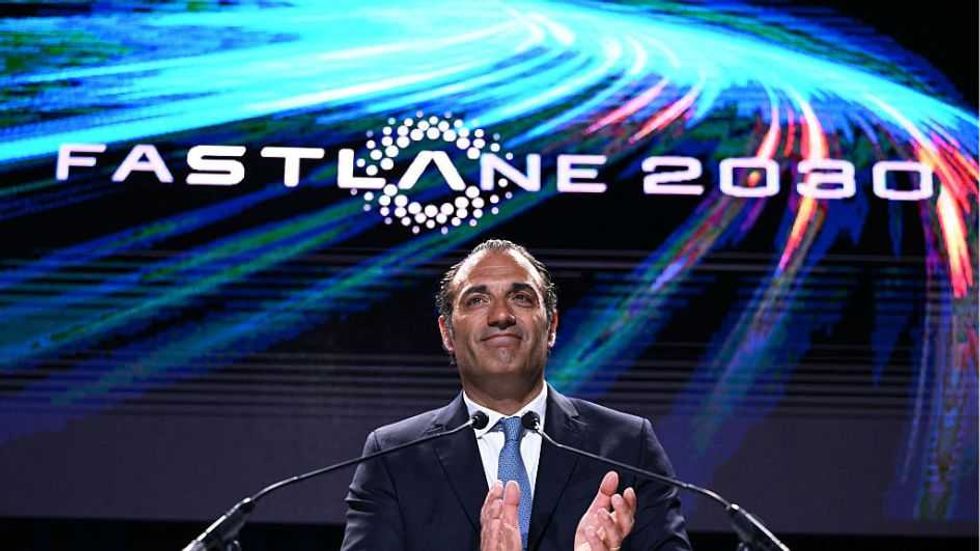
Image via The Blaze
Stellantis Bets the Farm on Chinese Partners — Just as Washington Calls Them a Threat
Here's a head-scratcher for you: While the federal government warns Americans that Chinese vehicles are rolling surveillance devices, Stellantis — the parent company of Jeep, Ram, and Chrysler — is doubling down on partnerships with Chinese automakers. The company's leadership is banking that cheaper manufacturing and access to Chinese battery tech will keep them competitive as the EV mandate steamrolls forward. Meanwhile, Washington slaps tariffs and security restrictions on Chinese cars, leaving Stellantis potentially caught in the crossfire of its own supply chain.
The gamble isn't just about cheap labor. Chinese firms have leapfrogged Detroit in battery technology and electric vehicle production capacity, and Stellantis knows it. But here's the rub: If tensions with Beijing escalate — and when have they not? — these partnerships could turn toxic overnight. Stellantis would be stuck retooling factories, finding new suppliers, and explaining to shareholders why they built their future on a foundation of Communist Party-controlled companies.
This is what happens when government mandates — like the EV push — collide with geopolitical reality. Auto manufacturers are being forced to choose between meeting arbitrary green energy deadlines and protecting American interests. They're choosing the path of least resistance, even if it means cozying up to a regime that steals our intellectual property and threatens Taiwan.
🏛 Wade's Take: If you're building a business that depends on partnerships with people who want to bury you, you're not running a business — you're running a ticking time bomb. Stellantis should be investing in American technology and American workers, not handing the keys to our automotive future to Beijing. When this blows up, and it will, don't expect taxpayers to bail them out again.
Image via Washington Examiner
Trump Signs Deal at Versailles, but Keeps Iran on Notice
President Trump walked out of the Palace of Versailles alongside French President Emmanuel Macron last night after signing a memorandum of understanding related to the interim Iran peace deal. When reporters shouted questions about whether the conflict with Iran was truly over, Trump's response was characteristically blunt: the deal is signed, but he's not making any promises about what comes next. The message was clear — America got something in writing, but Trump's keeping his powder dry.
The interim deal reportedly includes restrictions on Iran's nuclear program in exchange for limited sanctions relief, though details remain scarce. What's notable is the location and the company: Trump chose Versailles, the symbol of European diplomatic power, and stood shoulder-to-shoulder with Macron, signaling that this isn't just a bilateral agreement but part of a broader Western strategy. It's vintage Trump — big stage, controlled message, maximum leverage.
The Iran question has bedeviled American presidents for four decades. Trump's approach — maximum pressure followed by conditional deals — is exactly what you'd expect from someone who spent his life negotiating real estate. He's not looking for a legacy moment or a Nobel Prize. He's looking for American interests protected and adversaries kept off balance.
🏛 Wade's Take: I'll believe the Iran deal works when I see Tehran actually comply for more than six months. But give Trump credit — he's not pretending this is 'peace in our time' nonsense. He hit them hard, brought them to the table, got something in writing, and kept his options open. That's how you negotiate from strength, not weakness.

Image via National Review
California's Unions Push Another Tax-the-Rich Scheme — and Even Democrats Are Balking
The California labor movement has rolled out yet another initiative to squeeze more money from high earners, and this time even some Democrats are pumping the brakes. The proposed measure would slap additional taxes on the state's wealthiest residents to fund expanded union benefits and pension obligations. But here's the problem: California has already chased so many wealthy taxpayers to Nevada, Texas, and Florida that the math doesn't work anymore. The golden goose has left the state.
This is the unions eating their own. California Democrats have bent over backward for organized labor for decades, delivering prevailing wage laws, pension guarantees, and regulatory frameworks that make it nearly impossible to build anything without union labor. Now the unions want more, but the politicians are finally realizing there's no money left. When you tax and regulate the productive class into exile, eventually you run out of other people's money — even in California.
The initiative is polling poorly even among Democratic voters, who are starting to connect the dots between sky-high taxes, deteriorating services, and the endless demands of public sector unions. If this thing fails at the ballot box, it'll be a rare moment of fiscal sanity in Sacramento, driven not by principle but by the simple reality that you can't tax people who've already moved.
🏛 Wade's Take: Organized labor in California has had a blank check for so long they forgot basic economics — you can't fund gold-plated pensions if the people paying for them have already fled to Texas. This isn't conservatism winning; it's progressivism collapsing under its own weight. But I'll take it.

Image via American Thinker
Democrats in a Bind: If Trump's Iran Deal Works, They Lose
Here's a delicious irony: If President Trump's interim peace deal with Iran actually succeeds, Democrats face a political nightmare heading into 2028. For years, the left has insisted that Trump's foreign policy was reckless, that his withdrawal from the Obama-era Iran nuclear deal destabilized the Middle East, and that only sophisticated multilateral diplomacy could contain Tehran. Now Trump has potentially delivered what they said was impossible — a deal that constrains Iran's nuclear program without giving away the store.
The political calculus is brutal for Democrats. If the deal holds and Iran remains in compliance, Trump gets credit for achieving through strength what Obama couldn't achieve through appeasement. If the deal falls apart, Trump can blame Iranian bad faith and use it to justify even tougher measures. Either way, Democrats are stuck defending a record of failure — the Obama deal that put Iran on a glide path to nuclear weapons, and their own insistence that Trump's approach would lead to war.
This is the fundamental difference between conservative and progressive foreign policy. Conservatives believe in peace through strength — hit your adversaries hard, make them understand the cost of aggression, then negotiate from a position of dominance. Progressives believe in peace through concession — give your adversaries what they want upfront, hope they reciprocate, and call it diplomacy when they pocket your concessions and ask for more.
🏛 Wade's Take: Democrats spent five years saying Trump would start World War III with Iran, and instead he might end up with a better deal than anything they delivered. Their whole worldview is built on America apologizing and writing checks; Trump's is built on America winning. Voters notice the difference.
Mike Pence Still Doesn't Understand Why His Party Moved On
Former Vice President Mike Pence rolled out his new book at the National Press Club recently, and the central theme appears to be blaming 'anti-war populism' for everything he thinks has gone wrong with the Republican Party. Pence's argument is that the GOP's growing skepticism toward foreign interventions and nation-building has weakened America's standing in the world and abandoned our allies. It's a familiar refrain from the old guard, and it's just as tone-deaf now as it was in 2016.
What Pence refuses to acknowledge is that the American people — including millions of Republicans — are done writing blank checks for forever wars that don't advance American interests. We spent twenty years, trillions of dollars, and thousands of American lives in Afghanistan, and the Taliban controls the country again. Iraq is a client state of Iran. Libya is a failed state. Syria is a mess. The foreign policy establishment that Pence represents delivered failure after failure, then called anyone who noticed 'isolationist.'
The populist turn in the GOP isn't anti-war; it's anti-stupid war. Republican voters still support a strong military and defending American interests. They just don't support using American blood and treasure to export democracy to places that don't want it, can't sustain it, and will revert to chaos the moment we leave. Pence represents a Republican Party that no longer exists, and his book tour is basically a nostalgia act for a failed foreign policy consensus.
🏛 Wade's Take: Pence is a good man who served honorably, but he's fighting yesterday's battles. The Republican Party moved on because the old foreign policy playbook bankrupted us and failed repeatedly. Trump understood that before Pence did, which is why one of them is president and the other is on a book tour.
Stay sharp and stay invested. — Wade
— Wade Lawson