Sponsored By:
The AI revolution is here—and I've identified 9 powerhouse companies with real US operations, proven revenue growth, and deep AI integration that are primed to dominate. From a hidden chip maker set to power domestic AI manufacturing to a cloud provider ready for explosive growth, these aren't the tired "AI hype" stocks everyone's talking about.
The smart money is already watching, and once they move, these stocks could soar. Don't be the last to catch this wave—get the complete details on all 9 game-changing companies in my FREE report before opportunity passes you by.
Get the Free ReportBy clicking this link you agree to receive emails from StockEarnings and our affiliates. You can opt out at any time. Privacy Policy.

News For Every Conservative

Image via American Thinker
Responsibility: The “Unwritten Constitution” That Actually Keeps Us Free
America’s founders gave us a brilliant framework, but a framework isn’t a culture. The piece argues that free societies don’t survive on parchment guarantees alone—they survive on people practicing self-restraint, duty, and basic moral responsibility when nobody’s watching.
That’s not an abstract point. If you hollow out the habits that make liberty workable—marriage, faith, work ethic, civic virtue—you don’t get “more freedom.” You get more rules, more lawsuits, more bureaucracy, and more “experts” hired to manage the chaos.
✍ My Take: Every regulator I’ve ever dealt with showed up after somebody proved they couldn’t govern themselves. Responsibility is the cheapest law enforcement program ever invented—and the only one that scales. If we want less government, we better raise citizens who don’t need a babysitter.
Is China Playing Iran Like a Chess Piece While Washington Plays Checkers?
The American Conservative makes the case that Beijing stands to gain from America’s latest Middle East entanglements, with Iran functioning—directly or indirectly—as a pressure point against U.S. interests. If the region stays unstable, energy prices stay jumpy, shipping risk premiums rise, and China gets more leverage buying discounted oil while America spends blood and treasure.
China doesn’t have to fire a shot to win. It just has to keep our attention, our dollars, and our military assets tied down—while it locks up resources, expands trade influence, and positions itself as the “reasonable” alternative on the world stage.
✍ My Take: Markets hate uncertainty, and China loves when America exports it. Every time Washington drifts into another open-ended mess, small businesses pay it first—fuel, insurance, freight, and interest rates reacting to the shock. A serious America protects sea lanes, deters bad actors, and stops acting like we’ve got unlimited money for foreign fires while our own house needs repairs.
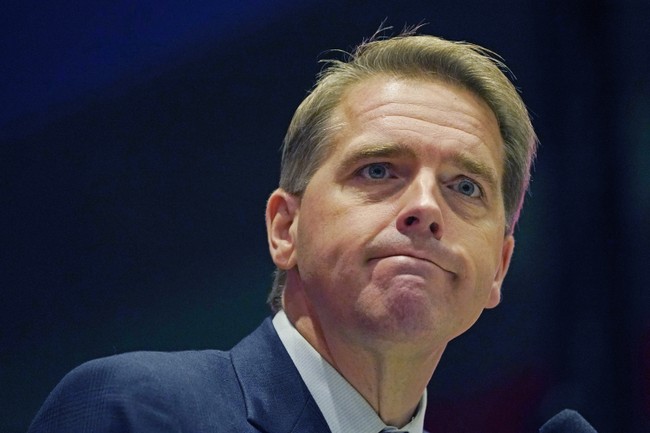
Image via PJ Media
Scott Jennings Puts the Gerrymandering Race Hustle on Trial
PJ Media highlights a segment where Scott Jennings takes on a former Daily Beast editor over gerrymandering and race, pushing back on the idea that every political map is proof of systemic racism. The exchange underscores a broader media habit: treat political strategy as illegitimate when it benefits Republicans, but “democracy in action” when it benefits Democrats.
Under the hood, this fight is about narrative control. If you can brand election outcomes as morally tainted, you can justify federalizing elections, weakening state authority, and expanding permanent administrative power.
✍ My Take: I’ve negotiated enough contracts to know the difference between tough terms and a rigged deal—and the left tries to call every loss “fraud” without using the word. If Democrats want fair maps, fine—set clear rules and apply them everywhere, not just in red states. The real endgame is centralized power, because centralized power is easier to capture and monetize.
📎 PJ Media

Image via The Western Journal
A Drone Hits a United Jet at 3,000 Feet — Welcome to the New Public Safety Failure
The Western Journal reports a United Airlines flight crew said their aircraft struck a drone around 3,000 feet while approaching San Diego. If accurate, this is the kind of incident that turns a manageable nuisance into a full-blown safety crisis—because near airports, margins are thin and consequences are instant.
We’ve normalized drone chaos: hobbyists, pranksters, and irresponsible operators treating controlled airspace like a playground. Meanwhile, enforcement is spotty, rules are uneven, and airports are left reacting instead of preventing.
✍ My Take: When you can buy a serious drone with two clicks and no real accountability, this outcome isn’t surprising—it’s inevitable. If the FAA and DOJ can’t enforce existing law, they’ll respond the only way bureaucracies know how: sweeping restrictions that punish responsible operators and businesses. Handle the bad actors now, or everybody gets regulated later.
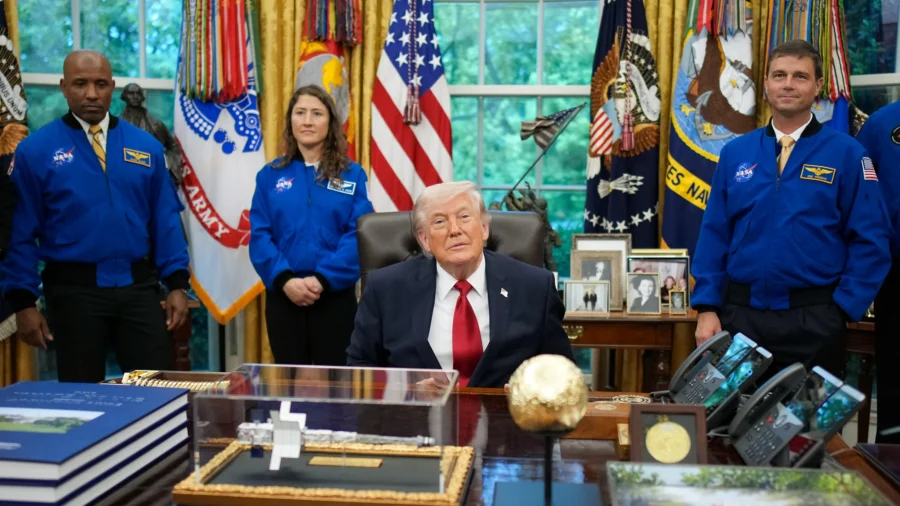
Image via NTD
Trump Meets Artemis II Crew — Space as Strategy, Not a Science Fair
NTD reports President Trump met with the Artemis II astronauts at the White House. The symbolism matters: Artemis isn’t just about hero shots and headlines—it’s about industrial capacity, national prestige, STEM talent pipelines, and whether America intends to lead in space or subcontract leadership to competitors.
Space policy connects directly to the real economy: aerospace manufacturing, supply chains, satellite networks, defense applications, and the next wave of commercial innovation that spins off into private markets.
✍ My Take: The country that leads in space leads in technology, and the country that leads in technology leads in wealth and security. If we can fund endless bureaucratic programs, we can fund a serious national effort that actually produces engineering, jobs, and strategic advantage. I’d rather invest in rockets than in another alphabet-agency “equity initiative” that can’t pass an audit.
📎 NTD
I’m Wade Lawson—build something real, protect what you’ve built, and don’t let Washington spend your future.
— Wade Lawson